Underwriting Case Studies
I got my start in the industry by underwriting Station Park at 10245 86 Ave NW, which I later managed through development as the Development Manager at Beljan Development. Since then, I’ve developed my own formula and process to quickly assess whether a site is worth building on.

Station Park – From Concept to Completion
In 2020, while working with Beljan Development, I prepared a detailed feasibility and design proposal for a modular Sea-Can retail village at the corner of Whyte Avenue and Gateway Boulevard in Edmonton. The vision was to convert the underused parking lot adjacent to MKT restaurant into a dynamic, transit-themed retail destination using shipping containers. I conducted a full pencil test on the financials, proposed a leasing strategy, outlined marketing and branding opportunities, and identified risks tied to permitting and insulation challenges with modular builds. The concept, dubbed “Platform 1907” or “Gateway Station”, aimed to celebrate the heritage of the nearby CPR rail line while introducing flexible, lower-cost retail options in the heart of Strathcona.That initial proposal set the stage for what would eventually become Station Park, a two-phase container-based retail and food hall development that I led from acquisition through construction as part of my capstone project in 2025. The first site was acquired in 2019, and the full development cycle spanned four years of entitlements, redesigns, rezoning, city negotiations, and tenant onboarding. Our first concept, a fully containerized site, was approved verbally by the City to extend onto parkland but was later revoked, forcing a pivot. We redesigned the project into two phases: Phase 1, a traditional 11-bay retail strip, and Phase 2, a modular Sea-Can village on city-owned land with a five-year lease. I led the rezoning, permitting, and lease negotiations, including removing the historic resource designation on the north parcel.Phase 1 broke ground in Spring 2022, with construction completing in Summer 2023. Phase 2 followed, launching in Winter 2022 and finishing in Spring 2024. The total project cost reached approximately $8.8 million, with containers used in Phase 2 providing placemaking, interim leasing, and market activation benefits. These modular units housed pop-up retail, event spaces, and food vendors, helping us create a vibrant destination while preserving the site’s historic roots.This project taught me how to turn early feasibility work into a fully executed development. From financial modeling to navigating municipal policy, from marketing activations to tenant fit-outs, Station Park became a real-world expression of a vision I first scoped out five years prior.
01

Fulton Place Land Assembly – Edmonton, AB
Earlier this year, I underwrote a land assembly in Fulton Place involving four adjacent lots at 5203–5211 101A Ave NW, totaling just over 18,000 square feet. The properties were zoned RS (Small Scale Residential), but I identified an opportunity to rezone to RM h16, which allows for a 2.3 FAR and up to four storeys of medium-scale residential development.I ran a full feasibility analysis based on the proposed rezoning. The site could yield roughly 41,600 square feet of buildable area. Using conservative development cost estimates at $220 per square foot, the total project cost came in around $20.5 million. I projected 59 residential units at an average rent of $1,300 per month, generating over $924,000 in annual rental income and a net operating income of approximately $538,000. Based on prevailing cap rates at the time (around 4.6%), the stabilized asset value was estimated at $11.7 million. Despite the gap between development cost and end value, I showed how the deal could still work with strategic rezoning, cost optimization, and investor structuring. The land itself was likely to appreciate significantly post-rezoning and assembly—by as much as 100–225%.Ultimately, I recommended a conditional offer to lock in the current land price while the client explored feasibility, met with the city, and secured early-stage design input. This case was a strong example of how targeted rezoning and structured due diligence can transform a speculative site into a viable development opportunity.
02
10827 111 St – Greenfield Redevelopment
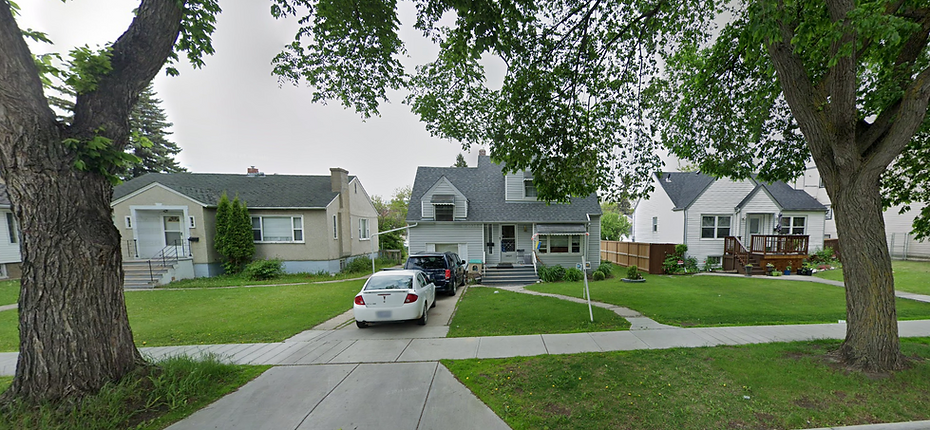
I recently completed an underwriting assessment for a developer on a potential infill redevelopment site at 10827 111 Street NW in Edmonton. The site, located in Queen Mary Park, was zoned RM h16, allowing for medium-scale residential development up to four storeys. The total lot size was 697 m², and with a Floor Area Ratio (FAR) of 2.3, the maximum buildable area came to approximately 1,603 m². Using an 85% efficiency assumption, I estimated the net rentable area at 1,362 m².Based on the zoning regulations and the absence of a minimum unit size requirement, I determined that the site could support up to 45 micro-units, averaging 30.2 m² (or roughly 320–400 sq ft) each. While this achieved the maximum density allowed, I advised the client that the layout would be tight and likely only viable as student or affordable housing, given the unit size constraints.The total development cost was estimated at $5.41 million, which included approximately $3.79 million in hard costs (calculated at $220 per sq ft over 17,222 sq ft) and $1.62 million in soft costs. The land value was estimated at $389,000, resulting in a cost per door of approximately $128,926.I also provided guidance on setbacks, assuming a 10% ground floor reduction to account for typical side and rear setbacks ranging from 3 to 4.5 metres, with possible adjustments based on adjacent uses or landscaping. At the time of assessment, there were no overlays or rezoning applications in effect for the site.Overall, this case demonstrated how zoning capacity doesn’t always translate to functional design. While the density was technically feasible, I recommended further testing of unit layouts and market fit before proceeding. The developer appreciated the clarity and speed of the feasibility analysis, especially in identifying the trade-offs between zoning allowances and end-user livability.
03

Mogul at Holyrood
Zoning: RM h16Lot Size: 2,608.91 m²FAR: 2.3Target: Feasibility analysis for a multi-family development on an infill site in Edmonton.Phase 1: Highest and Best Use (Initial Concept)My first approach was to test the site’s highest and best use by maximizing the allowable density under RM h16 zoning. Using the 2.3 FAR, I calculated a total buildable area of 6,000.49 m². After accounting for setbacks, parking, garbage storage, and easements (estimated at 20% deductions), the net buildable area was approximately 5,000.41 m². Spanning six stories (five above grade + one basement level), this yielded ~833.40 m² per floor. Assuming 80% efficiency (rentable area/net buildable), the total leasable area came to 4,167 m². Dividing that over a minimum 45-unit count, the average unit size was 92.60 m² (997 ft²), a generous layout per unit.
04